Comparison
GEO vs SEO
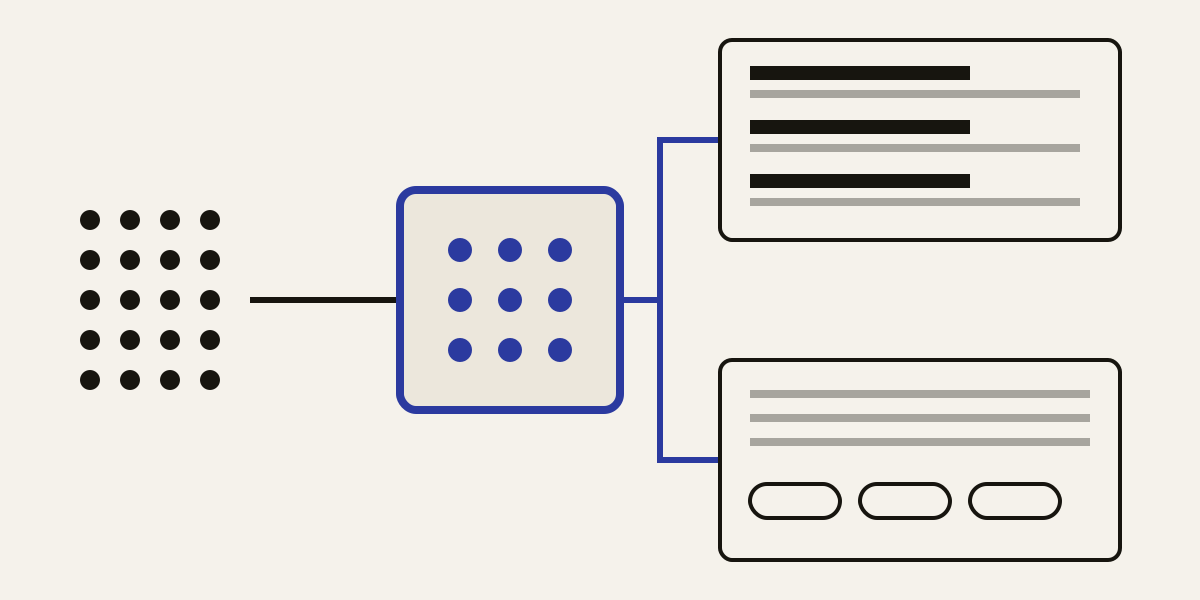
GEO, generative engine optimization, is work aimed at getting content shown in AI-generated answers; the term comes from a 2023 research paper. SEO is helping search engines understand your content and helping people find your site. For Google, the difference is small: Google says its AI Overviews and AI Mode rely on its core ranking systems, so optimizing for them is still SEO. The GEO paper studies generative engines in general, not Google alone.
Sources read 11 October 2026 · by the Heddle team
GEO and SEO, side by side
What it aims at
GEO
The GEO paper by Aggarwal and colleagues, accepted to KDD 2024, defines GEO as a way to help content creators improve how visible their content is in generative engine responses. Generative engines answer queries by gathering information from multiple sources and summarizing it with large language models.
arxiv.orgSEO
Google's SEO Starter Guide defines SEO as helping search engines understand your content, and helping users find your site and decide whether to visit it through a search engine.
developers.google.comHow Google classifies it
GEO
Google says AEO and GEO describe work focused on visibility in AI search experiences. From Google Search's perspective, optimizing for generative AI search is optimizing for search, and so it is still SEO. Google tells site owners to check third-party GEO advice against its guidance on evaluating SEO advice.
developers.google.comSEO
Google says SEO best practices stay relevant for generative AI search, because its AI features are rooted in its core Search ranking and quality systems. They retrieve pages from the Search index to ground their answers.
developers.google.comWhere your content appears
GEO
Content appears inside a synthesized answer. The GEO paper notes that creators have little to no control over when and how their content is displayed. Google says its AI features show prominent, clickable links to the pages that support a response.
arxiv.orgSEO
Content appears as a search result. Google's guide focuses on the title link and the snippet because they are the most visually significant parts of a result, and says a good title is unique to the page, clear and concise, and accurately describes its contents.
developers.google.comTechnical eligibility
GEO
To be eligible for Google's generative AI features, a page must be indexed and eligible to show in Search with a snippet. The site must also be included in Search generative AI features in Search Console. Google adds that it never promises indexing or serving.
developers.google.comSEO
Google says most sites are found automatically by its crawlers, mainly through links from other pages. You can check whether you are indexed with the site: operator. Submitting a sitemap is optional.
developers.google.comContent that works
GEO
Google says unique, non-commodity content will likely influence presence in generative AI search more than any other suggestion. Its example of such content is a first-hand review rather than a summary of what is already published.
developers.google.comSEO
Google says compelling, useful content will likely influence search presence more than any other suggestion. It describes such content as easy to read, unique, up to date, helpful and reliable.
developers.google.comKeywords and query variations
GEO
Google says you do not need to rewrite content for AI or chase every long-tail variation, because its AI systems understand synonyms. It warns that creating separate pages for fan-out queries mainly to manipulate AI responses violates its scaled content abuse spam policy.
developers.google.comSEO
Google suggests thinking about the words readers use, such as charcuterie versus cheese board. It also says not to worry about every variation, because its language matching can relate a page to queries that use other words.
developers.google.comTactics Google says you can skip
GEO
For Google Search, Google says you can ignore llms.txt files and other special AI markup, breaking content into small chunks, special schema for AI, and seeking inauthentic mentions. It says Google Search ignores llms.txt.
developers.google.comSEO
Google's SEO guide says there are no secrets that will automatically rank a site first. It also says many suggestions, such as reorganizing URLs or canonicalizing duplicates, are helpful but not urgent.
developers.google.comMeasuring results
GEO
Google points to the Generative AI performance report in Search Console. It warns that no third-party tool has access to its internal ranking or AI systems. In the GEO paper's own benchmark, GEO-bench, its methods raised visibility by up to 40 percent, and results varied by domain.
arxiv.orgSEO
Google says some changes take effect within hours and others take months. It suggests waiting a few weeks before judging whether a change helped, and using the URL Inspection Tool to see a page as Google sees it.
developers.google.comWhich to choose
You want to appear in Google AI Overviews or AI Mode
SEO. Google says these features are grounded in its core ranking systems and that optimizing for them is still SEO, so the same practices apply.
Your pages are not indexed by Google yet
SEO first. A page must be indexed and eligible for a snippet before it can appear in Google's generative AI features.
You care about visibility in generative engines other than Google Search
GEO, as the research describes it. The paper studies generative engines in general, and it found that what works differs by domain, so test methods in your own field.
A vendor pitches GEO built on llms.txt files, content chunking or special schema
SEO basics instead. Google says Google Search ignores llms.txt, that you don't need to chunk content for AI and that there's no special schema to add, and it tells you to judge such advice against its own guidance.
You want to know whether AI search is sending you visitors
Either label works. For Google, use the Generative AI performance report in Search Console, and be wary of tools that claim to use internal Google metrics.
When Heddle is the wrong choice
Heddle publishes this page and sells a service that aims to rank businesses in Google and AI answers, so it has a stake in this topic. Heddle is the wrong choice if you want a published price, because it quotes each plan only after a free search audit (heddle.pro/pricing).
It is also the wrong choice if you need results in days. Heddle says stages one to six, from intake to indexed pilot pages, usually take three to five weeks, and the first decision to expand or prune lands around two and a half months in (heddle.pro/how-it-works).
It does not suit a business that wants to start with video or ads, since every business starts with Search (heddle.pro/pricing). You will have to do some of the work yourself: Heddle asks for the claims you can back with evidence, a named person to approve each agent's work, and read access to Search Console (heddle.pro/how-it-works).
If you want link pitches sent or ad budgets spent without a person signing off, Heddle will not do that, because a named person signs every pitch and its paid boost agent never launches or spends (heddle.pro/agents).
How this comparison was made
We read the primary sources first, the research paper and the search engines' own documentation, on 11 October 2026. Heddle's page families agent drafted the comparison from them, and every statement on either side links to where it came from.
The page then passed the same gates as every page on this site, including a check of each fact against its source. How that agent works
Sources
Questions
Is GEO different from SEO?
For Google Search, no. Google says optimizing for its generative AI features is optimizing for search, and so still SEO. The GEO paper treats it as a separate approach for generative engines in general.
Do I need an llms.txt file for GEO?
Not for Google. Google says Google Search ignores llms.txt and similar files, and that creating one neither helps nor harms visibility there. It adds that other services may use such files.
Is SEO still relevant with AI search?
Yes. Google says SEO best practices remain relevant because its AI Overviews and AI Mode retrieve pages from its Search index using its core ranking systems.
Where does the term GEO come from?
It comes from the paper GEO: Generative Engine Optimization by Aggarwal and colleagues, first submitted to arXiv in November 2023 and accepted to KDD 2024.
Work with us
Let the agents bring you the leads.
Tell us about your business and who buys from you. On a short call we'll show you the searches your buyers make where you don't show up yet, and what the agents would do about them in their first month.
On the call, for your site
- The searches your buyers makeMeasured, with how many people make each one
- Where you show up, and where you don'tOn Google and in ChatGPT's answers
- The agents' first monthThe pages, fixes and links they would start with